
Aswan Tour Guide Tips | How to Hire the Right Guide in Aswan in 2026
Learn how to hire the right Aswan Tour Guide. Compare prices, verify licenses, and book a private guide A ...
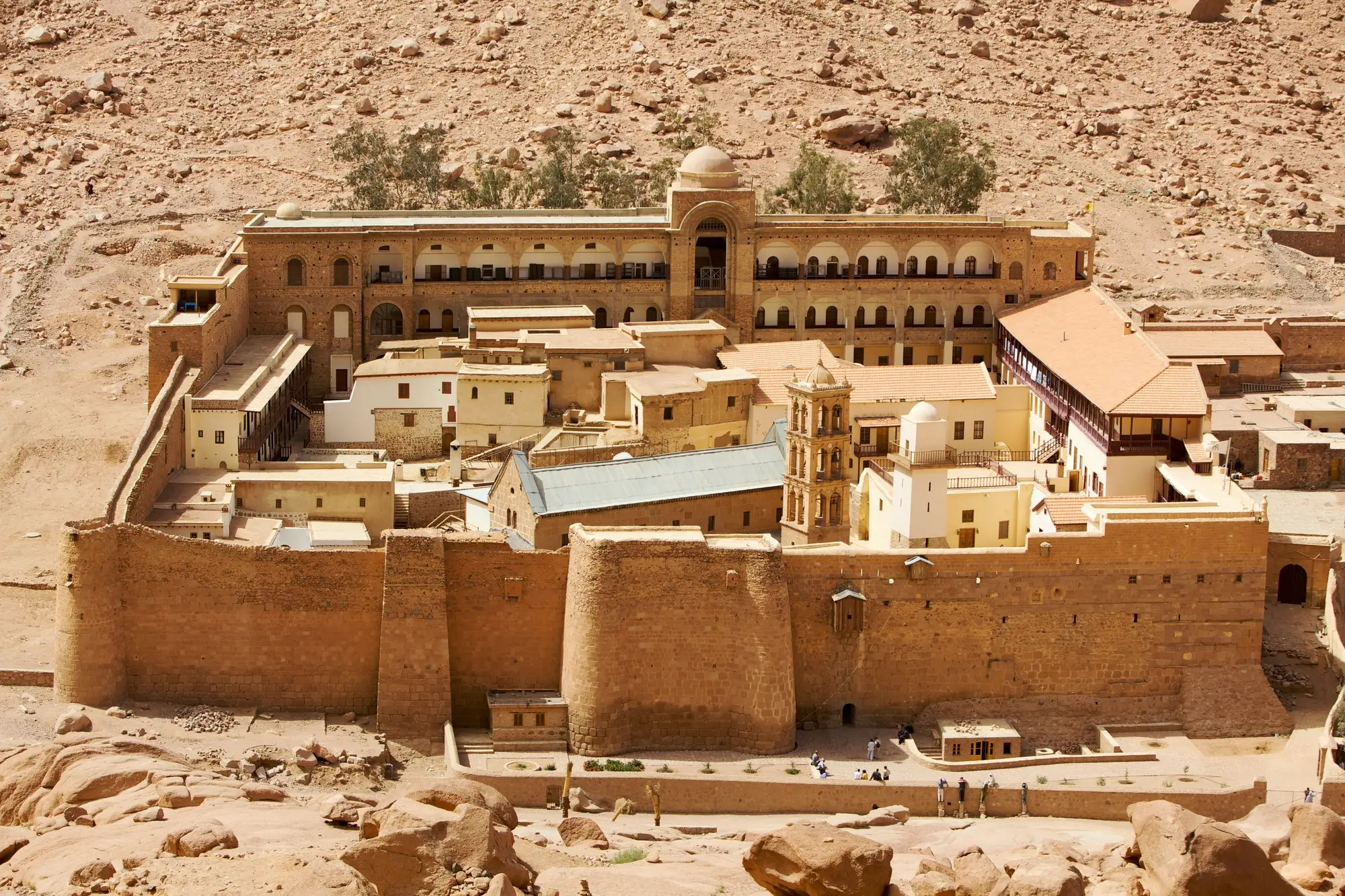
Perched at the foot of Mount Sinai, Saint Catherine's Monastery is one of the world's oldest continuously operating Christian monasteries and a UNESCO World Heritage site. This complete guide covers the ST Catherine Monastery's fascinating history — from the Burning Bush to Emperor Justinian — along with practical visitor information, what to see inside, and tips for climbing Mount Sinai. Whether you're planning a pilgrimage or a day trip from Sharm El Sheikh, this guide to Saint Catherine's Monastery at Mount Sinai helps you experience one of Egypt's most sacred and historically significant sites.
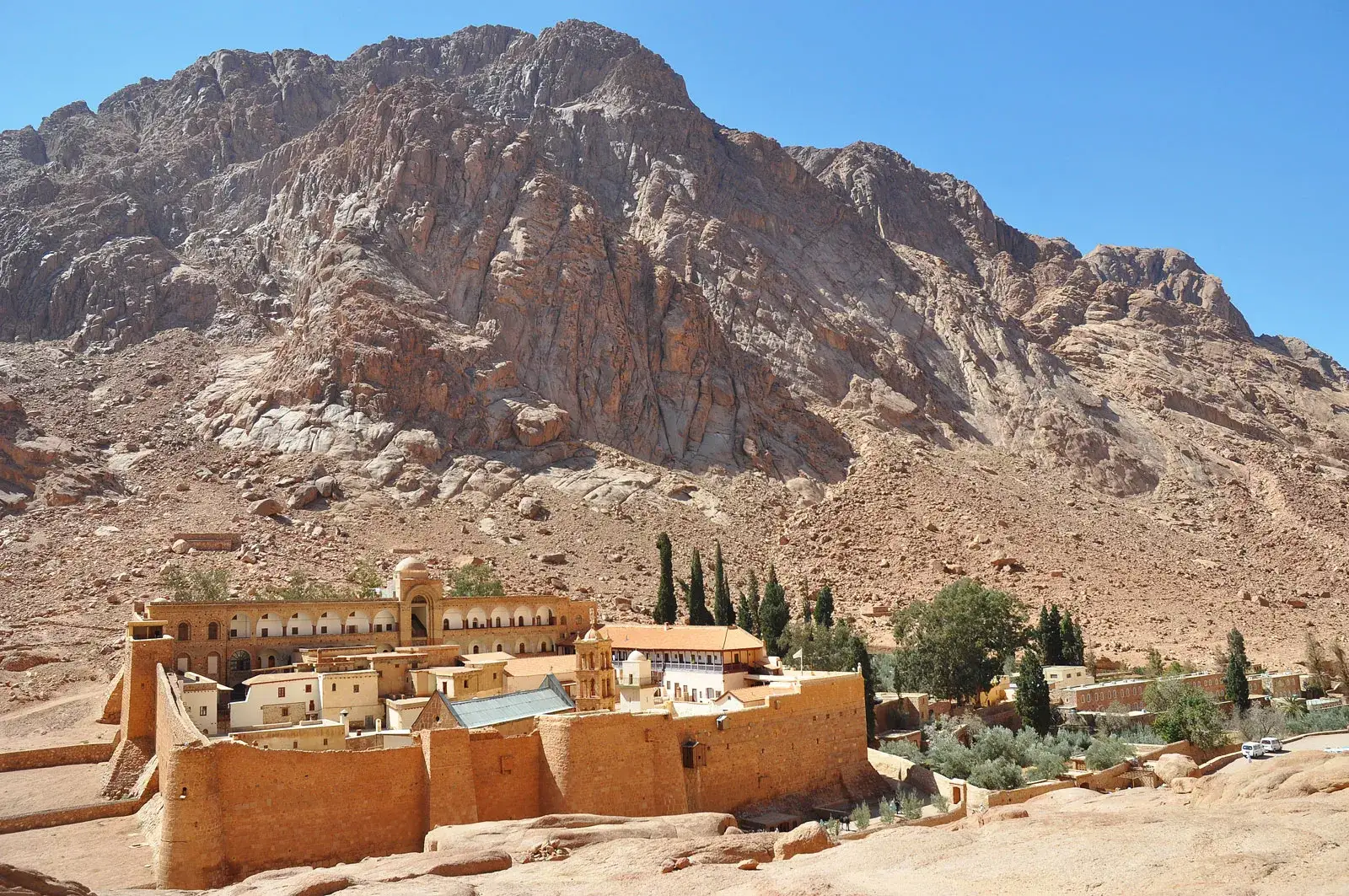
Saint Catherine's Monastery (also known as ST Catherine Monastery, Catherine Monastery, or Saint Catherine's Monastery at Mount Sinai) is one of the oldest continuously operating Christian monasteries in the world. Located at the foot of Mount Sinai — the biblical mountain where Moses received the Ten Commandments — this UNESCO World Heritage site has been a center of pilgrimage, scholarship, and monastic life for over 1,500 years.
The Saint Catherine's Monastery complex is a remarkable blend of faith, history, and architecture. Its massive granite walls rise from the stark desert landscape of Egypt's Sinai Peninsula, enclosing a world of ancient churches, priceless manuscripts, and the living bush that tradition identifies as the Burning Bush of Moses. For Christians, ST Catherine Monastery is one of the holiest sites on earth, revered as the place where God spoke to Moses from the flames.
Today, Saint Catherine's Monastery at Mount Sinai attracts visitors from around the world — pilgrims, history lovers, and travelers seeking to connect with one of the most sacred places in the Abrahamic traditions. Whether you're exploring the Catherine Monastery's library of ancient manuscripts or climbing Mount Sinai for sunrise, this site offers an experience that is both spiritually profound and historically extraordinary.
The story of Saint Catherine's Monastery begins with one of the most famous events in the Bible. According to the Book of Exodus, Moses was tending his flock near Mount Horeb (traditionally identified with Mount Sinai) when he saw a bush that burned with fire but was not consumed. From the flames, God spoke to Moses, calling him to lead the Israelites out of Egypt.
This sacred site — the traditional location of the Burning Bush — became the foundation upon which Saint Catherine's Monastery was built. Today, the Saint Catherine's Monastery complex encloses the Chapel of the Burning Bush, built directly over the roots of what is believed to be the original bush.
In the 4th century AD, Empress Helena — mother of the Roman Emperor Constantine — made a pilgrimage to the Holy Land and ordered the construction of a small chapel at the site of the Burning Bush. This chapel was dedicated to the Virgin Mary and marked the beginning of Christian presence at Mount Sinai.
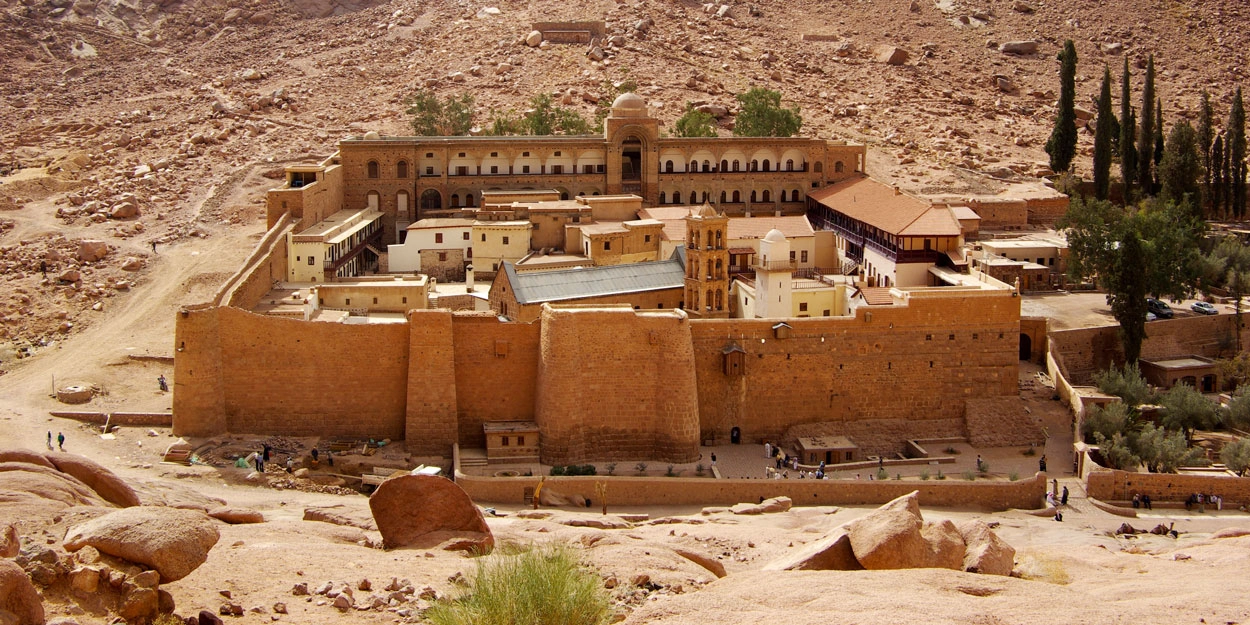
The monastery as we know it today was built by order of the Byzantine Emperor Justinian I between 527 and 565 AD. Justinian's engineers constructed a massive fortress around the Burning Bush chapel, creating a fortified monastery that could withstand attacks from bandits and hostile forces.
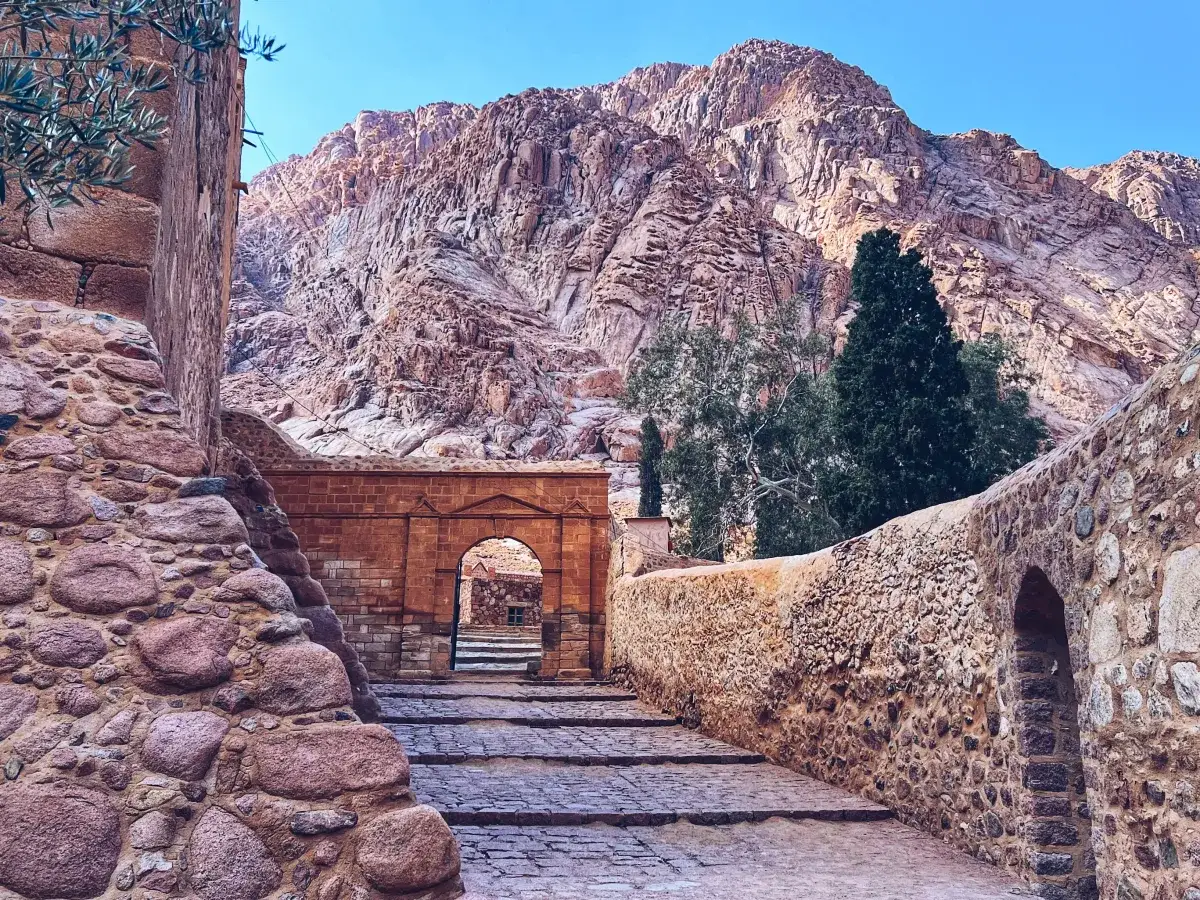
The walls of Saint Catherine's Monastery rise to nearly 20 meters (65 feet) and enclose a complex of churches, monks' cells, a refectory, an olive press, and the famous library. This fortress design was so effective that the monastery has never been captured or destroyed in its 1,500-year history.
The monastery was originally dedicated to the Transfiguration of Christ, but it was later renamed after Saint Catherine of Alexandria — a 4th-century Christian martyr whose relics were said to have been discovered in the Sinai region. According to tradition, angels transported Saint Catherine's body to the peak of Mount Sinai, where it was found by monks and brought to the monastery.
One of the most remarkable chapters in the ST Catherine Monastery's history is its relationship with Islam. In the 7th century, the Prophet Muhammad granted the monastery a charter of protection, known as the Achtiname of Muhammad, which guaranteed the monks' safety and freedom of worship. This document is still displayed in the monastery today.
Throughout the centuries, Saint Catherine's Monastery has survived the rise and fall of empires, wars, and political upheaval. It has been visited by pilgrims, scholars, and rulers from across the world — from Empress Catherine of Russia to Napoleon Bonaparte. Today, it remains a functioning Orthodox monastery, home to a small community of monks who continue the tradition of prayer, hospitality, and scholarship.
In 2002, Saint Catherine's Monastery was added to UNESCO's World Heritage List, recognizing its outstanding universal value as a cultural and religious site.
The Library of Saint Catherine's Monastery is one of the oldest continuously functioning libraries in the world. It holds approximately 3,300 manuscripts in a variety of languages, including Greek, Arabic, Latin, Georgian, and Syriac.
The collection includes:
The library's treasures include early copies of the Septuagint (the Greek translation of the Hebrew Bible) and important Christian writings from the early centuries of the church. The collection is second in number only to the Vatican Library, making it one of the most significant manuscript collections in the world.
In addition to the manuscripts, the library houses 8,000 old books (including 7,000 written in Greek and 957 early prints) and 5,000 modern books. The monastery's archive includes documents dating back to the mid-15th century.
The Chapel of the Burning Bush is the spiritual heart of Saint Catherine's Monastery. Located behind the main altar of the Church of the Transfiguration, this small chapel is built directly over the roots of the legendary burning bush. The living bush itself — believed to be a direct descendant of the original — grows in the monastery's courtyard.
The Church of the Transfiguration is the monastery's main church, built during the reign of Emperor Justinian. It features stunning Byzantine architecture, with marble columns, gold mosaics, and a beautifully decorated iconostasis. The church's mosaics date back to the 6th century and are among the finest surviving examples of early Byzantine art.
The monastery houses an exceptional collection of religious icons, some dating back to the early centuries of Christianity. The Icon Gallery displays works of art that illustrate the development of Byzantine iconography over more than a millennium.
Within the walls of Catherine Monastery, visitors can also find a 12th-century Fatimid mosque, which was built to accommodate the monastery's Muslim visitors and workers. The complex also includes the monks' living quarters, a refectory, an olive press, and ossuaries containing the remains of monks who have lived at the monastery over the centuries.
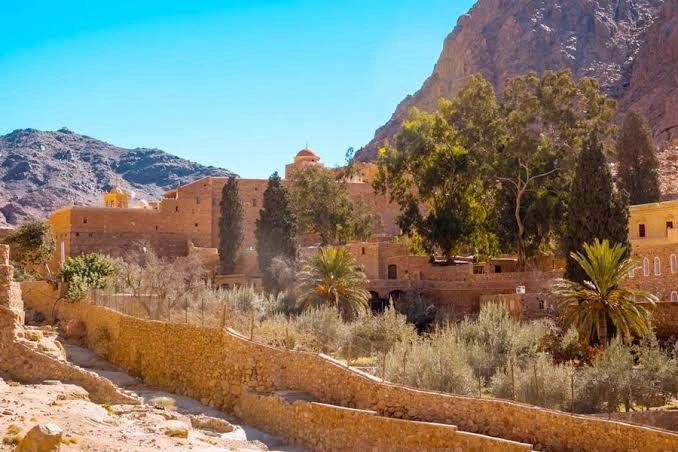
For many visitors, climbing Mount Sinai (also known as Jebel Musa) is the highlight of a trip to Saint Catherine's Monastery at Mount Sinai. The mountain rises to 2,285 meters (7,497 feet) above sea level, and the hike to the summit is a challenging but rewarding experience.
The ascent: Most visitors begin the climb in the late evening or early morning to reach the summit in time for sunrise. The traditional route follows the Camel Path, a relatively wide and well-maintained trail that takes about 2.5 to 3 hours to ascend. For a more adventurous climb, the Steps of Repentance — a steep staircase of over 3,700 steps — offers a more direct but strenuous route.
The summit: At the top of Mount Sinai, visitors are rewarded with breathtaking views of the surrounding desert and mountains. As the sun rises over the Sinai Peninsula, the landscape transforms from darkness to a palette of gold and red. This is the same vista that has inspired pilgrims for centuries — a moment of profound beauty and spiritual reflection.
Practical tips: The climb is physically demanding, so wear sturdy shoes and bring plenty of water. The temperature can drop significantly at night, even in summer, so pack warm layers. Many tour operators offer guided Mount Sinai climbs, often combined with a visit to the monastery.
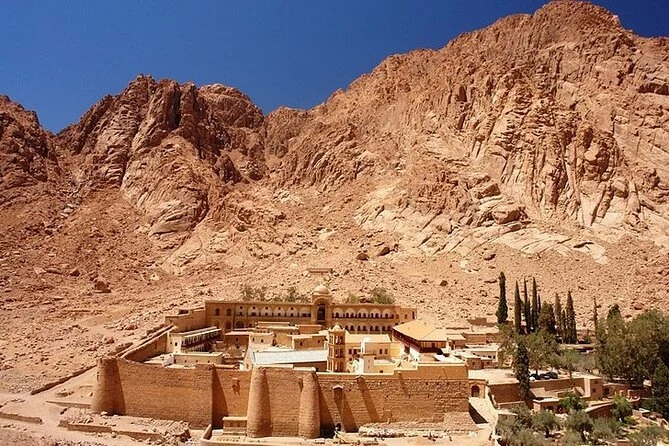
Saint Catherine's Monastery is located in the Sinai Peninsula of Egypt, approximately 300 kilometers (186 miles) from Sharm El Sheikh and 450 kilometers (280 miles) from Cairo.
How to get there:
Saint Catherine's Monastery is open to visitors daily, though hours are limited:
It is always recommended to check current opening hours before your visit, as they can shift around religious holidays.
Entry: There is a small entrance fee to enter Saint Catherine's Monastery.
Dress code: As a functioning religious site, modest clothing is required:
Important: The Chapel of the Burning Bush is not always open to the public, and visitors may need special permission to enter.
The best time to visit Saint Catherine's Monastery is during the cooler months from October to April, when daytime temperatures are pleasant (ranging from 20°C to 25°C / 68°F to 77°F). This period offers the most comfortable conditions for exploring the monastery and climbing Mount Sinai.
Spring (March–May) and Autumn (September–November) are the ideal seasons for hiking:
Summer (June–August): Can be scorching hot during the day, making hiking uncomfortable. The monastery can also be packed with tourists during peak season.
Winter (December–February): Daytime temperatures are cool, and it can occasionally snow on Mount Sinai. This is a beautiful time for those seeking snowy, quiet mountain scenes.
Pro tip: If you plan to climb Mount Sinai for sunrise, aim to be on the mountain between 4:00 AM and 6:00 AM. The experience of watching the sun rise over the Sinai desert is unforgettable.
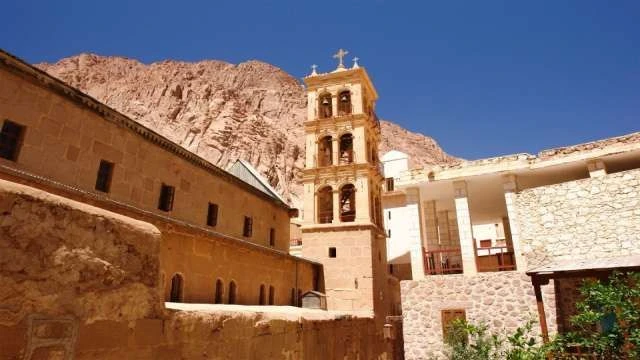
Saint Catherine's Monastery is one of the most extraordinary places on earth — a site where faith, history, and natural beauty converge in the heart of the Sinai desert. Standing before the Burning Bush, walking through the fortress walls built by Emperor Justinian, and climbing Mount Sinai to watch the sunrise over the desert are experiences that stay with you for a lifetime. But getting there isn't straightforward. The drive from Sharm El Sheikh takes over three hours. The monastery's limited opening hours demand careful planning. And without a guide, the layers of history — the relics of Saint Catherine, the mosaics of the Transfiguration, the manuscripts in the library — can feel overwhelming rather than illuminating.
That's where having the right people by your side makes all the difference. Tour Guides Egypt connects you with local professionals who know Saint Catherine's Monastery inside out. Our Local Tour Guides don't just show you the sights — they bring the stories to life. They'll explain why the Burning Bush matters, decode the symbols in the 6th-century mosaics, and help you understand the significance of the monastery's manuscript collection. They know the best times to arrive, the quietest corners of the complex, and the routes up Mount Sinai that suit your fitness level. Behind the scenes, our Tour Representatives handle logistics — transport, timing, and coordination — so you can focus on the experience. And when you need to move between Sharm El Sheikh, Dahab, or Cairo, our Private Drivers provide comfortable, reliable transportation through the Sinai's desert roads.
For travelers who want more than just a day trip, we can help you combine your visit to Saint Catherine's Monastery with other experiences across Egypt. Whether you're planning a pilgrimage that includes climbing Mount Sinai for sunrise, a Red Sea beach holiday, or a comprehensive journey that connects the Sinai with Cairo and Luxor, we're here to help. You can plan a tailor-made Egypt trip that fits your schedule, your interests, and your budget.
Ready to experience Saint Catherine's Monastery? Reach out to us on [WhatsApp] for instant support — our team is ready to answer your questions about visiting ST Catherine Monastery, customize your Sinai itinerary, and turn your pilgrimage into an unforgettable journey. The sacred mountain is waiting — and we're here to guide you there.
Q: What is Saint Catherine's Monastery?
A: Saint Catherine's Monastery (also known as ST Catherine Monastery or Catherine Monastery) is one of the oldest continuously operating Christian monasteries in the world, located at the foot of Mount Sinai in Egypt's Sinai Peninsula. It is a UNESCO World Heritage site and home to the traditional site of the Burning Bush.
Q: Where is Saint Catherine's Monastery located?
A: Saint Catherine's Monastery is located in the Sinai Peninsula of Egypt, approximately 300 kilometers (186 miles) from Sharm El Sheikh and 450 kilometers (280 miles) from Cairo.
Q: What is the history of Saint Catherine's Monastery at Mount Sinai?
A: The Saint Catherine's Monastery at Mount Sinai was built by order of Emperor Justinian I between 527–565 AD, enclosing the traditional site of the Burning Bush where Moses encountered God. It was later renamed after Saint Catherine of Alexandria, whose relics were said to have been discovered nearby.
Q: What can I see inside Catherine Monastery?
A: Inside Catherine Monastery, you can see the Chapel of the Burning Bush, the Church of the Transfiguration with its 6th-century mosaics, an icon gallery, a 12th-century Fatimid mosque, and one of the world's oldest functioning libraries.
Q: What is the library of Saint Catherine's Monastery?
A: The library of Saint Catherine's Monastery is one of the oldest continuously functioning libraries in the world. It holds approximately 3,300 manuscripts in Greek, Arabic, Latin, Georgian, and other languages.
Q: What are the opening hours of Saint Catherine's Monastery?
A: Saint Catherine's Monastery is typically open during late morning hours for a few hours at a time. It is usually closed on Fridays, Sundays, and during major Orthodox holidays. Always check current hours before visiting.
Q: Is there an entry fee for Saint Catherine's Monastery?
A: Yes, there is a small entrance fee to enter Saint Catherine's Monastery.
Q: What is the dress code for visiting Catherine Monastery?
A: Modest clothing is required — cover shoulders and knees, and avoid revealing clothing. Remove hats when entering churches.
Q: Can I climb Mount Sinai from Saint Catherine's Monastery?
A: Yes, visitors can climb Mount Sinai (2,285 meters / 7,497 feet) from Saint Catherine's Monastery. The hike takes approximately 2.5 to 3 hours using the Camel Path, or you can take the steeper Steps of Repentance.
Q: What is the best time to visit Saint Catherine's Monastery?
A: The best time to visit Saint Catherine's Monastery is during the cooler months from October to April. Spring (March–May) and Autumn (September–November) offer mild weather ideal for hiking.
Q: Can I visit Saint Catherine's Monastery on a day trip from Sharm El Sheikh?
A: Yes, many visitors visit Saint Catherine's Monastery on a day trip from Sharm El Sheikh, which takes about 3–3.5 hours each way. Some tours include an overnight stay for those who want to climb Mount Sinai for sunrise. Check out our guide to the best things to do in Sharm El Sheikh for more ideas.
Q: Is Saint Catherine's Monastery safe for tourists?
A: Yes, Saint Catherine's Monastery is a safe and well-established tourist destination. Guided tours are recommended for the convenience of transportation and local expertise. As with any travel destination, exercise standard precautions.

Learn how to hire the right Aswan Tour Guide. Compare prices, verify licenses, and book a private guide A ...

Luxor Egypt tour guides 2026 — English guides from $70/day, other languages from $100/day. How to choose ...

Pompey's Pillar Alexandria 2026 — history, ticket prices, opening hours, and visitor tips. Complete guide ...
Get Updates & More
@ Copy 2026 Tour Guides Egypt , All rights reserved