Aswan Tour Guide Tips | How to Hire the Right Guide in Aswan in 2026
Learn how to hire the right Aswan Tour Guide. Compare prices, verify licenses, and book a private guide A ...

Step into the most complete ancient Egyptian temple ever discovered. This guide covers the Edfu temple Egypt — from its 180-year construction history to ticket prices and the legendary temple of Horus at Edfu. Whether you're visiting the Horus temple at Edfu on a Nile cruise or as a day trip from Luxor or Aswan, this guide helps you explore the temple of Edfu with confidence.
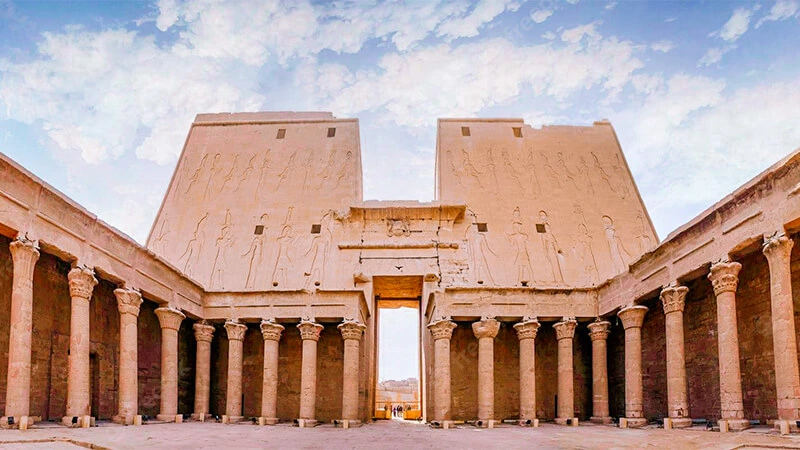
The Edfu temple Egypt — known officially as the Temple of Horus at Edfu — is the most completely preserved ancient Egyptian temple in existence. Located on the west bank of the Nile between Luxor and Aswan, this extraordinary monument offers visitors something no other temple in Egypt can: a complete picture of how these sacred buildings actually looked and functioned.
Dedicated to Horus — the falcon‑headed god, son of Osiris and Isis, and protector of the pharaohs — the Horus temple at Edfu was built during the Ptolemaic period between 237 and 57 BC. It took 180 years to complete, spanning the reigns of multiple Ptolemaic rulers from Ptolemy III to Ptolemy XII.
What makes the temple of Edfu truly unique is its extraordinary state of preservation. Unlike most Egyptian temples that were dismantled, quarried for building stone, converted to churches, or eroded over millennia, Edfu was buried under centuries of Nile silt and desert sand. This natural preservation kept its ceilings, its towering 36‑metre pylons, and even its original wooden shrine intact. When French archaeologist Auguste Mariette began excavating in 1860, he found a temple almost complete from foundations to roof.
Today, the temple of Horus Edfu Egypt stands as a UNESCO World Heritage site, part of Ancient Thebes and its Necropolis. It is a must‑visit stop on any Nile cruise between Luxor and Aswan and one of Egypt's most rewarding archaeological experiences.
The Edfu temple Egypt was not built by a single pharaoh but by a succession of Ptolemaic rulers over nearly two centuries. Construction began in 237 BC during the reign of Ptolemy III Euergetes. The main body of the temple — including the hypostyle halls and sanctuary — was completed by 122 BC. The outermost elements — the peristyle court with its 32 paired columns and the monumental entrance pylons — were finally added in 57 BC under Ptolemy XII.
The temple was built on the site of an earlier temple dating back to the 18th Dynasty (1567–1320 BC), and even earlier structures from the reign of Ramses III. The name "Edfu" itself derives from the ancient Egyptian name Djeba, later known as Behdet, which was the cult centre of Horus.
The temple of Horus at Edfu was more than a place of worship — it was the setting for one of ancient Egypt's most important religious reenactments. Inscriptions on the temple walls describe what is known as the "Sacred Drama" — the mythological conflict between Horus and Seth.
According to the myth, Horus sought revenge for the murder of his father Osiris at the hands of his uncle Seth. The story symbolised the eternal struggle between order and chaos, with Horus representing the fertile lands of the Nile and Seth representing the surrounding desert. This story was ceremoniously reenacted each year at the temple complex. The temple of Edfu was the centre of several festivals sacred to Horus, including the annual pilgrimage when Hathor travelled south from her temple at Dendera to visit Horus, marking their sacred marriage.
The extraordinary preservation of the Edfu temple is one of the most remarkable stories in Egyptian archaeology. By the time of the Islamic era, the town of Edfu had grown directly on top of the ancient temple complex. Mud‑brick houses were built on the accumulated silt that had covered the temple for centuries.
When Auguste Mariette began excavating in 1860, he had to demolish entire neighbourhoods of 19th‑century houses to reach the temple below. What he found was extraordinary: a temple with its complete superstructure intact, including both massive entrance pylons at full height, three complete hypostyle halls, the offering hall, the sanctuary, and its surrounding chapels — all roofed or partially roofed. Even the original wooden shrine that held the sacred statue of Horus still stands in the sanctuary.
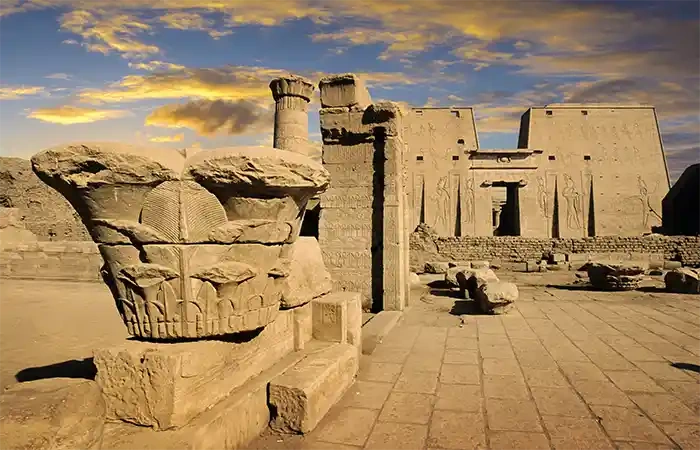
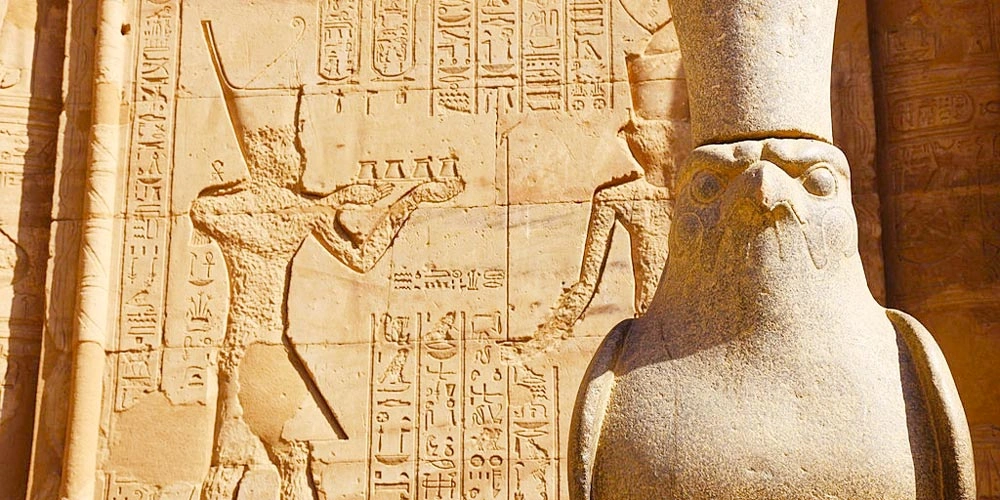
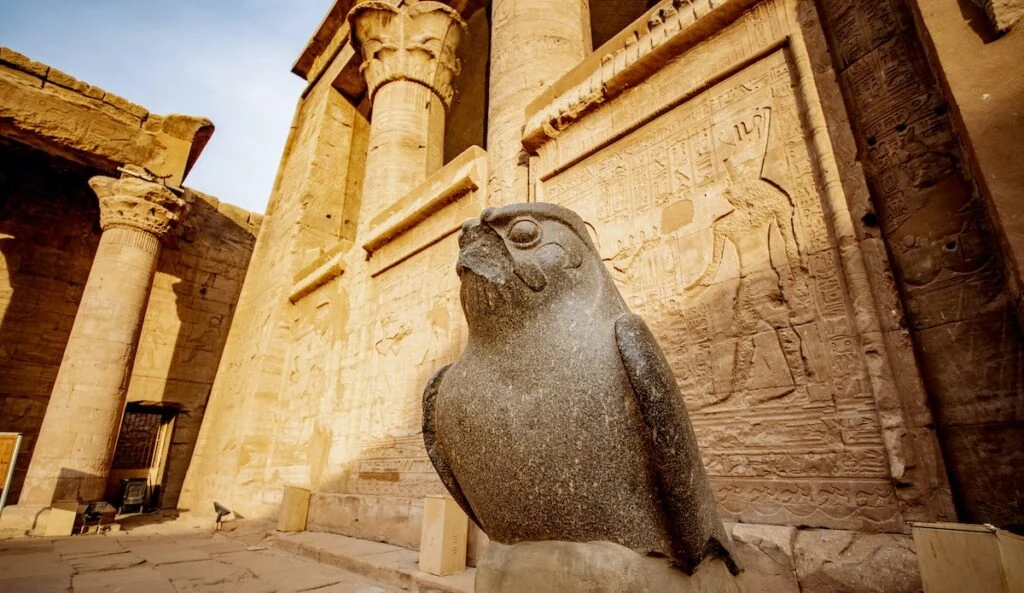
The two entrance pylons of the temple of Horus at Edfu rise 36 metres (118 feet) — the height of a 12‑storey building — and are the tallest and most complete pylon facade of any Egyptian temple. The exterior walls bear scenes of Ptolemy XII conquering his enemies and worshipping deities. Two large granite statues of the falcon‑god Horus stand guard before the pylons.
Beyond the pylons, visitors enter a large Peristyle court lined with columns decorated with floral capitals. This leads to two Hypostyle Halls. The first hall illustrates the temple's foundation, with the king engaged in worship. The second holds scenes of Horus' journey in a sacred bark, accompanied by the goddess Hathor. From there, visitors pass through the Transverse Hall to the Sanctuary.
At the heart of the Edfu temple lies the Sanctuary, where the cult statue of Horus was kept. The original wooden shrine that held the sacred statue still stands in place — an astonishing survival that gives visitors a direct connection to the temple's original function. The walls of the sanctuary and surrounding chapels are covered with well‑preserved reliefs and inscriptions that provide invaluable information on Ptolemaic religion, language, and mythology.
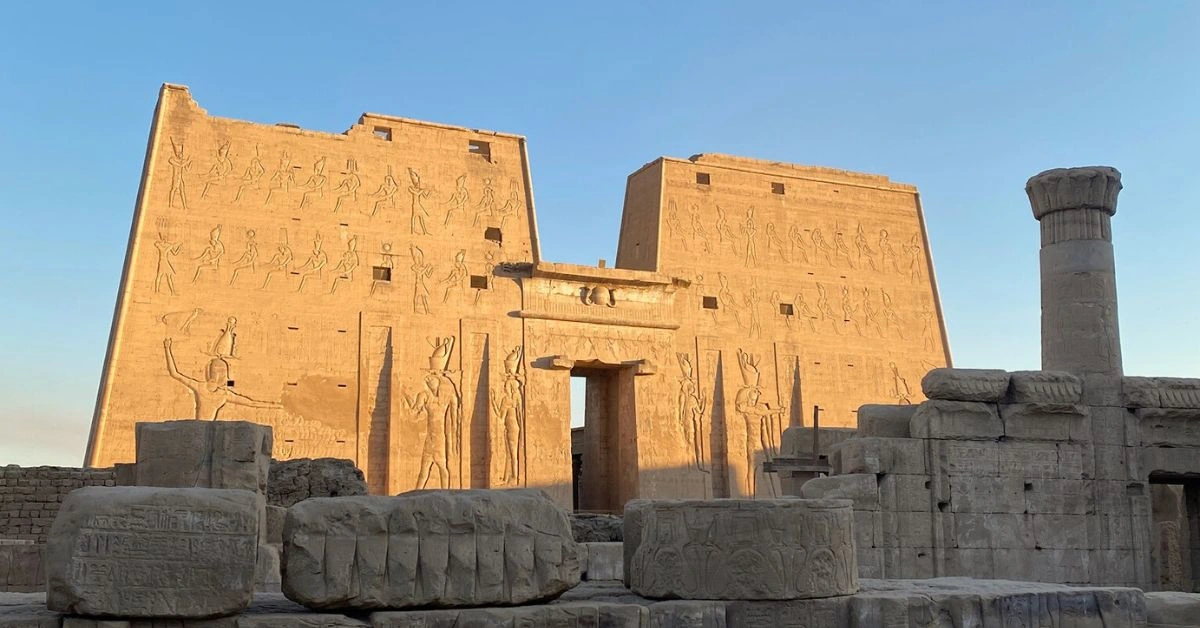
The Edfu temple is located on the west bank of the Nile in Upper Egypt, approximately 105 kilometres (65 miles) south of Luxor and 123 kilometres (76 miles) north of Aswan.
How to get there:
The Edfu temple is open daily:
Some sources report slightly different hours, so it's always best to check current timings before your visit. The temple is open year‑round, but hours can vary on public holidays.
Prices are estimates based on 2026 data and may change.
Note: Tickets can be purchased on-site at the new reception hall, which was recently revamped with additional electronic ticketing devices and gates to streamline visitor access.
One of the unexpected pleasures of visiting the Edfu temple from a Nile cruise is the calesh — the traditional horse-drawn carriage that takes passengers from the cruise dock through the streets of Edfu town to the temple entrance, approximately 2 kilometres away.
The calesh ride is included in most Nile cruise itineraries. The journey through the local market streets — past vegetable sellers, schoolchildren, and Egyptian daily life — creates a vivid contrast with the ancient world you are about to enter. It has become one of the most fondly remembered small details of the Nile cruise experience.
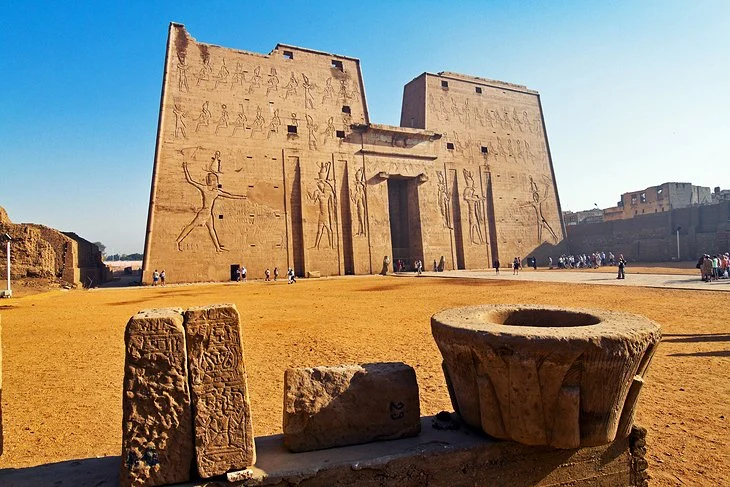
The best time to visit the temple of Horus at Edfu is early morning (6:00–9:00 AM) or late afternoon (4:00–6:00 PM).
Why early morning:
Why late afternoon:
Best months: The cooler months from October to April offer the most comfortable temperatures for exploring the Edfu temple. Summer months (June–August) can be extremely hot, though the temple's covered halls offer some respite from the sun.
Best days: Wednesdays and Sundays, when the temple opens at 6:00 AM, offer an extra hour for tranquil exploration.
For more on timing your Egypt trip, check out our guide to the best time to visit Egypt .
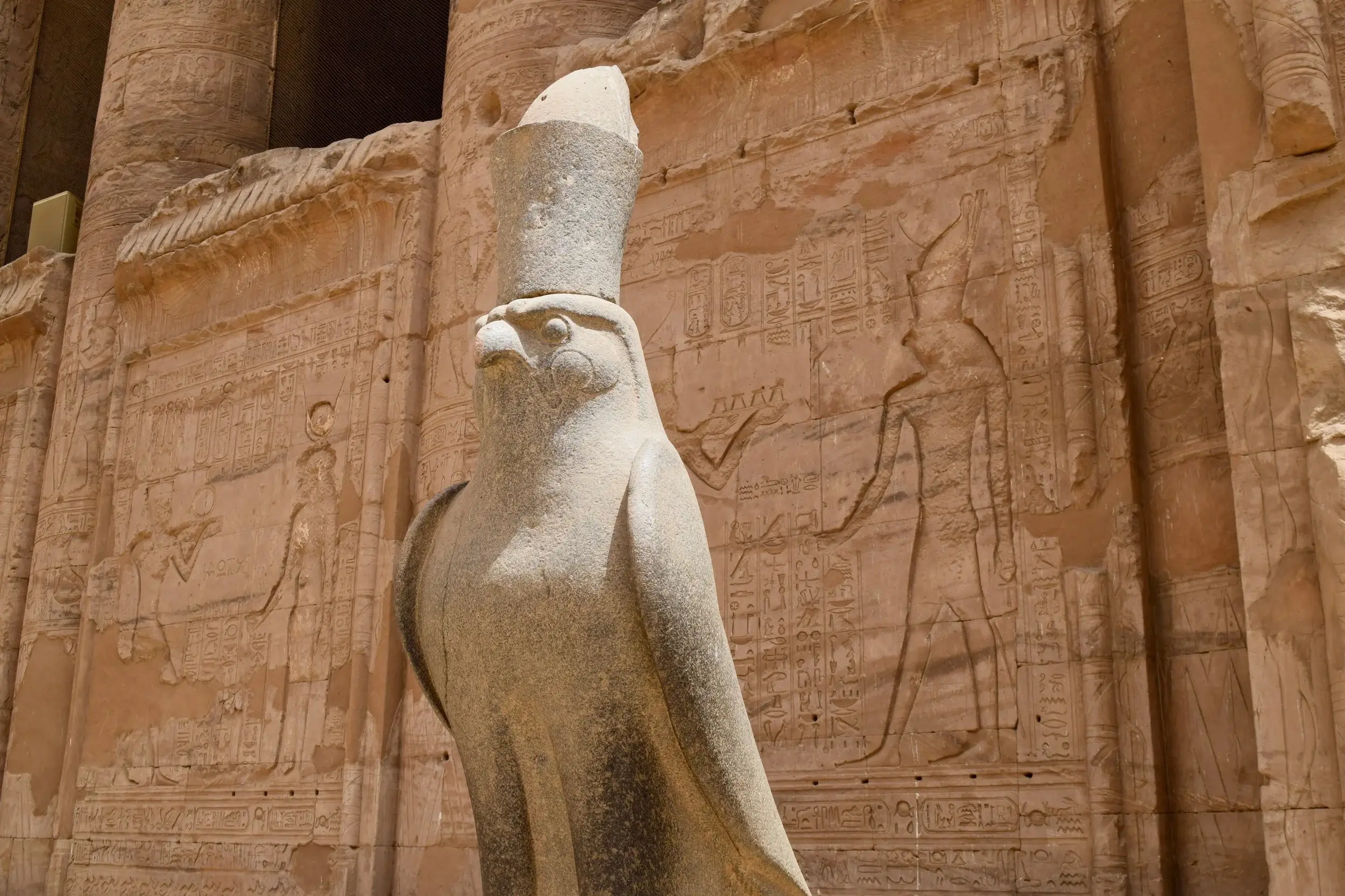
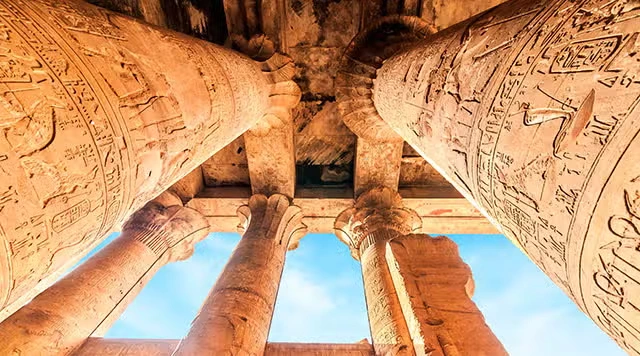
The Edfu temple Egypt is one of the most extraordinary ancient sites in the world — a temple so perfectly preserved that it offers a direct window into how ancient Egyptian religion actually functioned. Standing beneath the 36‑metre pylons, walking through the hypostyle halls with their ceilings intact, and seeing the original wooden shrine still in its sanctuary is an experience that no other temple in Egypt can replicate. The temple of Horus at Edfu is not a ruin — it is a complete ancient building, frozen in time by centuries of sand and silt.
But the Edfu temple can be challenging to navigate. The heat, the crowds, the layers of Ptolemaic history, and the logistics of getting there — especially if you're not on a Nile cruise — all demand planning and local knowledge. That's where having the right partner makes all the difference.
Tour Guides Egypt connects you with trusted local professionals who know the temple of Horus at Edfu inside out. Our Local Tour Guides are licensed Egyptologists who bring the temple to life — decoding the reliefs of the Sacred Drama, explaining the symbolism of Horus and Seth, and pointing out details that most visitors walk straight past. Our Tour Representatives handle logistics — tickets, transport, and timing — so you can focus on the experience. And when you need to move between the temple, your cruise, or other Aswan attractions , our Private Drivers provide comfortable, reliable transportation.
For travelers who want to combine the Edfu temple with other Nile Valley highlights — the Karnak Temple Complex , the Valley of the Kings , and Philae Temple Aswan — we can help you design a comprehensive itinerary. You can also plan a tailor-made Egypt trip that includes the temple of Edfu along with Cairo, Luxor, and the Nile.
For more inspiration, check out our guides to Aswan attractions , Luxor attractions , and Nile River cruise prices .
Ready to explore the best-preserved temple in Egypt? Reach out to us on [WhatsApp] for instant support — our team is ready to answer your questions about the Edfu temple Egypt, customize your itinerary, and turn your Egyptian dream into reality. The Temple of Horus is waiting — and we're here to help you discover it.
Q: What is the Edfu temple Egypt?
A: The Edfu temple Egypt — also known as the Temple of Horus at Edfu — is the most completely preserved ancient Egyptian temple in existence. Dedicated to the falcon god Horus, it was built between 237 and 57 BC during the Ptolemaic period.
Q: Where is the temple of Horus at Edfu located?
A: The Horus temple at Edfu is located on the west bank of the Nile in Upper Egypt, approximately 105 kilometres south of Luxor and 123 kilometres north of Aswan.
Q: How old is the Edfu temple?
A: The Edfu temple was built over 180 years, beginning in 237 BC and completed in 57 BC — making it over 2,000 years old.
Q: Who built the temple of Edfu?
A: The temple of Edfu was built by a succession of Ptolemaic rulers, beginning with Ptolemy III in 237 BC and completed under Ptolemy XII in 57 BC.
Q: How much are Edfu temple tickets in 2026?
A: Edfu temple tickets cost approximately 500 EGP (~$10 USD)** for foreign adults and **250 EGP (~$5 USD) for students.
Q: What are the Edfu temple opening hours?
A: The Edfu temple is open daily from 6:00 AM to 6:00 PM in summer and 6:00 AM to 5:00 PM in winter.
Q: What is the calesh ride at Edfu?
A: The calesh is a traditional horse‑drawn carriage that takes visitors from the Nile cruise dock through Edfu town to the temple entrance, approximately 2 kilometres away.
Q: What is the best time to visit the temple of Horus at Edfu?
A: The best time to visit the Horus temple at Edfu is early morning (6:00–9:00 AM) or late afternoon (4:00–6:00 PM) for cooler temperatures and better light.
Q: What is the Sacred Drama at the Edfu temple?
A: The Sacred Drama was an annual reenactment of the mythological conflict between Horus and Seth, inscribed on the walls of the temple of Edfu.
Q: Is the Edfu temple wheelchair accessible?
A: The Edfu temple has some accessibility challenges due to steps and uneven surfaces. Check current accessibility before your visit.
Q: Can I visit the temple of Edfu on a day trip from Luxor?
A: Yes. The temple of Horus at Edfu is approximately 105 kilometres from Luxor and can be visited as a day trip by private car or as part of a Nile cruise.
Q: Do I need a guide for the Edfu temple?
A: While you can visit independently, a licensed Egyptologist guide can explain the reliefs, the Sacred Drama, and the significance of the Edfu temple. For more on guide costs, check out our guide to Egypt tour guide price .
Q: What is the best currency to take to Egypt?
A: The best currency to take to Egypt is US dollars or euros, which are widely accepted. The Egyptian pound (EGP) is used for daily expenses.
Q: Is it safe to visit the Edfu temple?
A: Yes. Egypt is safe for tourists who follow standard precautions. The Edfu temple is a well‑established tourist destination with a strong security presence.
Q: Do I need a visa to visit Egypt?
A: Most nationalities require a visa. Check the Egypt visa on arrival countries list to see if you qualify. US citizens can obtain an Egypt visa on arrival or apply for an e‑Visa.

Learn how to hire the right Aswan Tour Guide. Compare prices, verify licenses, and book a private guide A ...

Luxor Egypt tour guides 2026 — English guides from $70/day, other languages from $100/day. How to choose ...

Pompey's Pillar Alexandria 2026 — history, ticket prices, opening hours, and visitor tips. Complete guide ...
Get Updates & More
@ Copy 2026 Tour Guides Egypt , All rights reserved