
Aswan Tour Guide Tips | How to Hire the Right Guide in Aswan in 2026
Learn how to hire the right Aswan Tour Guide. Compare prices, verify licenses, and book a private guide A ...

Standing sentinel over Alexandria for over 1,700 years, Pompey's Pillar is the city's last surviving ancient monument. This complete guide covers the Pompey's Pillar Alexandria history, the legendary misnomer, ticket prices, opening hours, and what to see among the ruins of the Serapeum. Whether you're visiting the Pillar Alexandria on a day trip from Cairo or exploring Alexandria's Roman heritage, this guide helps you discover one of Egypt's most remarkable historical landmarks.
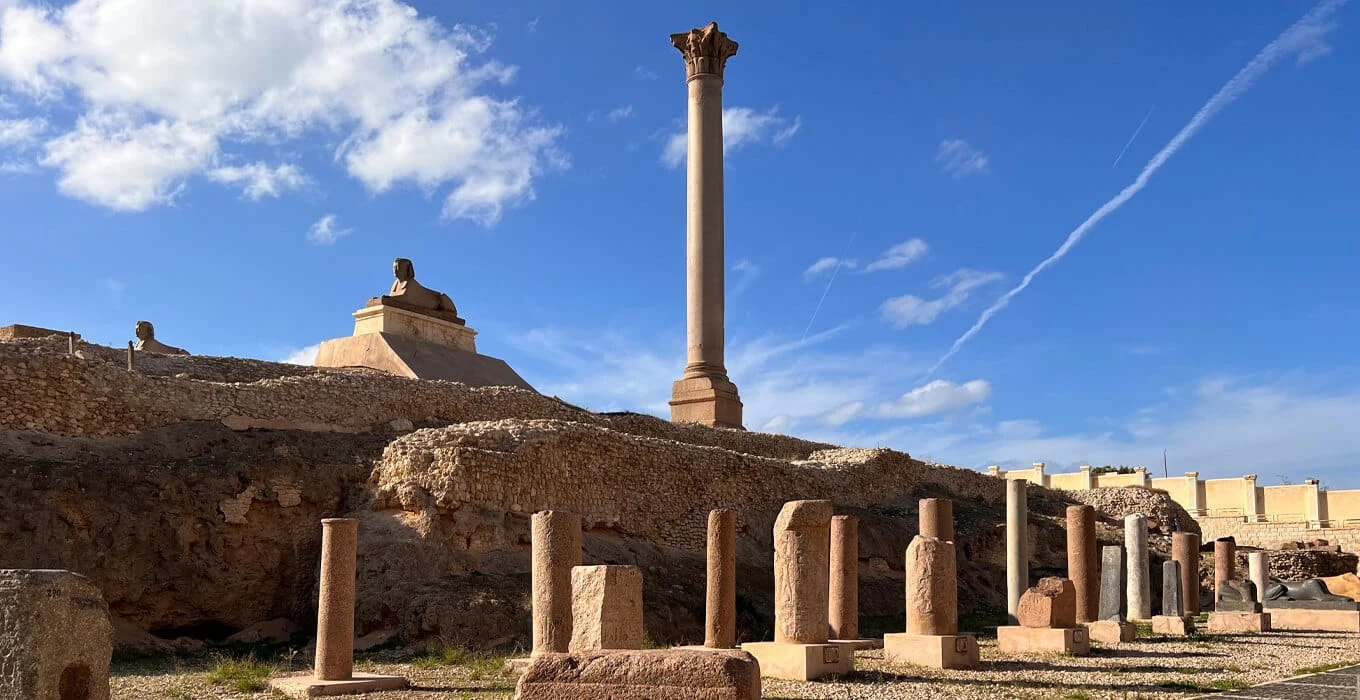
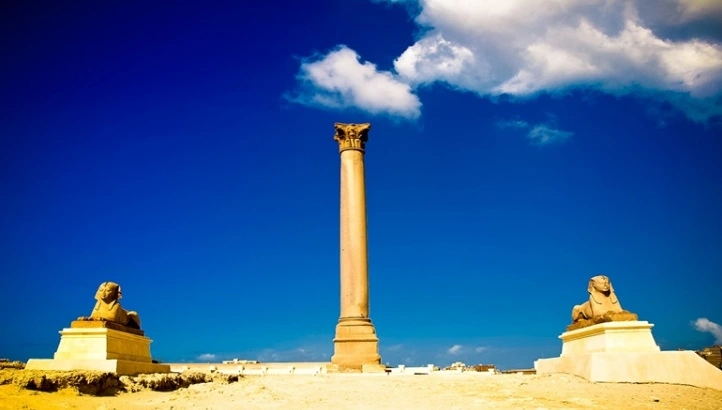
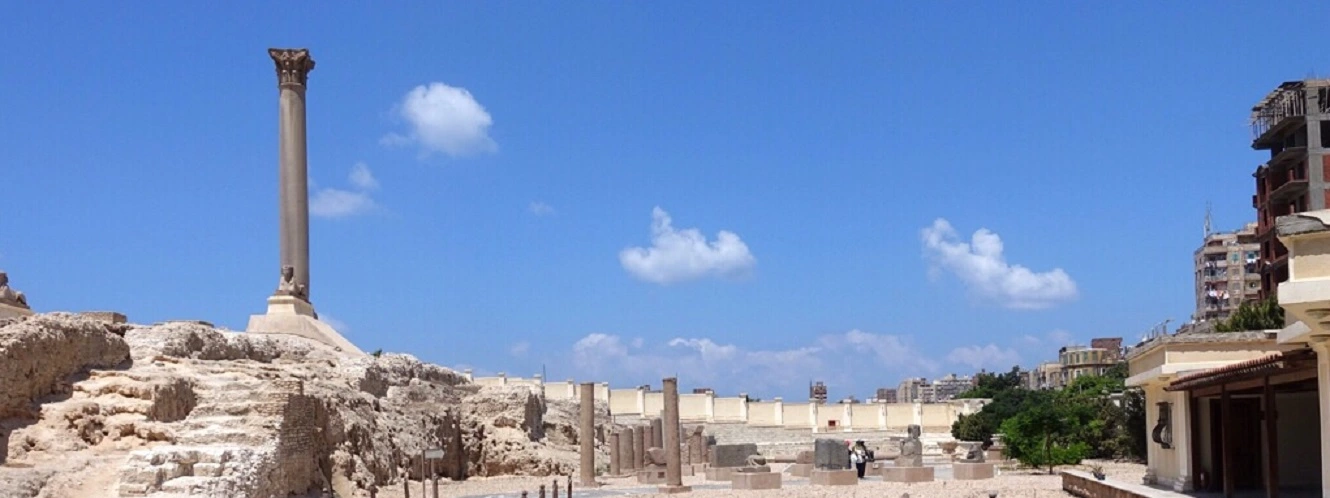
Pompey's Pillar (Arabic: عمود السواري, Amoud El-Sawari) is the largest ancient monolithic column outside Rome and the only ancient monument in Alexandria still standing in its original location. Towering approximately 27 metres (89 feet) above the Karmouz hill in western Alexandria, this magnificent red granite column is one of Egypt's most impressive Roman-era monuments.
Despite its famous name, Pompey's Pillar has nothing to do with the Roman general Pompey the Great, who was murdered in Egypt in 48 BC. The column was actually erected between 298–302 AD in honour of the Roman Emperor Diocletian, following his suppression of a revolt in Alexandria.
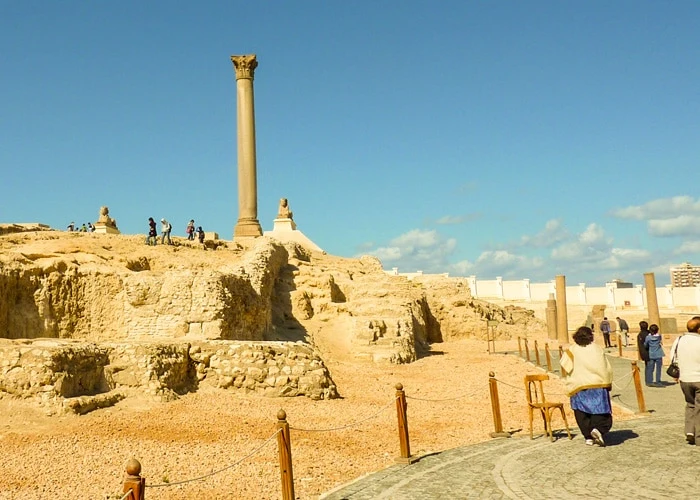
The Pillar Alexandria stands on the site of the ancient Serapeum — the great temple of the Greco-Egyptian god Serapis, once one of the most magnificent religious buildings in the Mediterranean world. Today, it is the last surviving monument from this once-magnificent complex, a testament to Alexandria's rich Greco-Roman heritage and one of the most important Alexandria landmarks.
For travellers exploring the city, Pompey's Pillar is an essential stop — a place where history, legend, and engineering converge in a quiet corner of Alexandria.
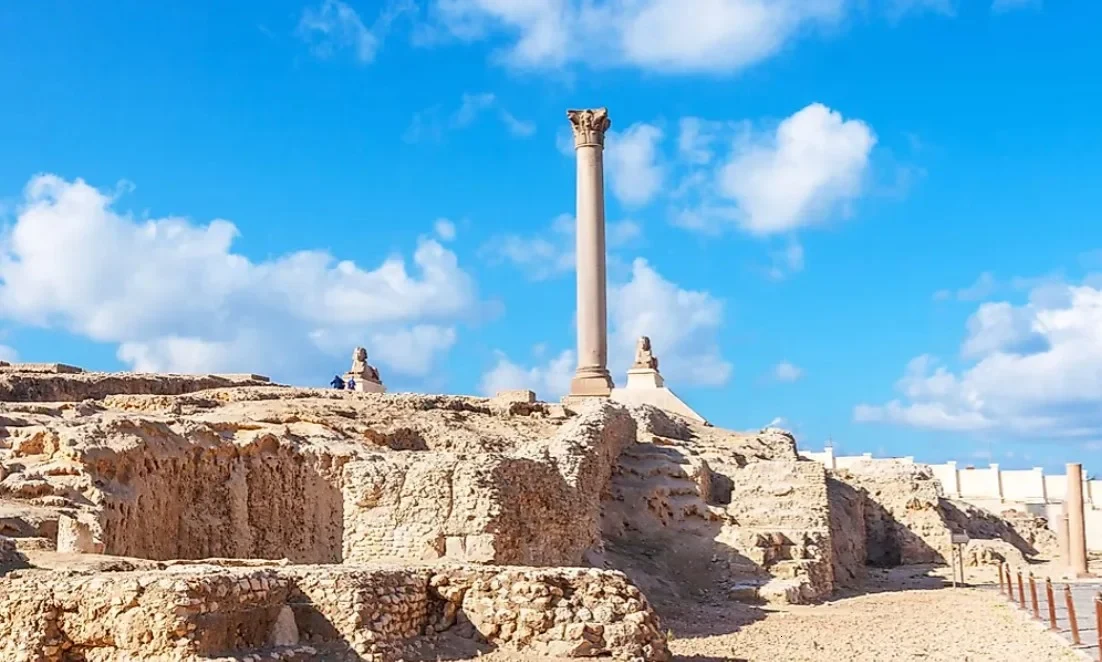
The name Pompey's Pillar is one of the most persistent misnomers in archaeology. The column has nothing to do with the Roman general Gnaeus Pompeius Magnus — Pompey the Great.
The confusion dates back to the medieval period. According to tradition, Crusaders believed that Pompey, who was assassinated in Egypt in 48 BC after fleeing from Julius Caesar, was buried at the site and that his head was placed in a container atop the column. The misidentification stuck, and the name has endured in European usage for over eight centuries.
The local Arabic name, Amoud El-Sawari (Column of the Horsemen), reflects a different tradition — perhaps derived from the Arabic word for "masts" (sawari), as the column would have towered among other columns like ship masts.
The Pompey's Pillar was actually erected in honour of the Roman Emperor Diocletian (ruled 284–305 AD), following his successful suppression of a revolt in Alexandria led by Lucius Domitius Domitianus.
The column was dedicated by Publius, the Roman governor of Egypt, and the Greek inscription on the base reads: "Postumas, a governor of Alexandria, erected this pillar in honour of a just emperor Diocletian". It was completed towards the end of the third century AD and was one of the largest columns of its type to be built anywhere in the Roman Empire.
The Pompey's Pillar stands on the eastern side of the temenos (sacred enclosure) of the Serapeum of Alexandria, a magnificent temple dedicated to the Greco-Egyptian god Serapis.
The Serapeum was built by Ptolemy III Euergetes in the 3rd century BCE and became one of the most celebrated temples in the ancient world. It housed a daughter library of the Great Library of Alexandria — a collection of scrolls that reportedly survived the main library's destruction.
In 391 AD, the Serapeum was destroyed by a Christian mob led by Bishop Theophilus, marking one of the final blows to the pagan religion in Egypt. The temple was razed, and whatever portion of the Library's collection was stored there was lost. Only Pompey's Pillar survived, standing alone among the ruins — a silent witness to the violent transition from the ancient to the Christian world.
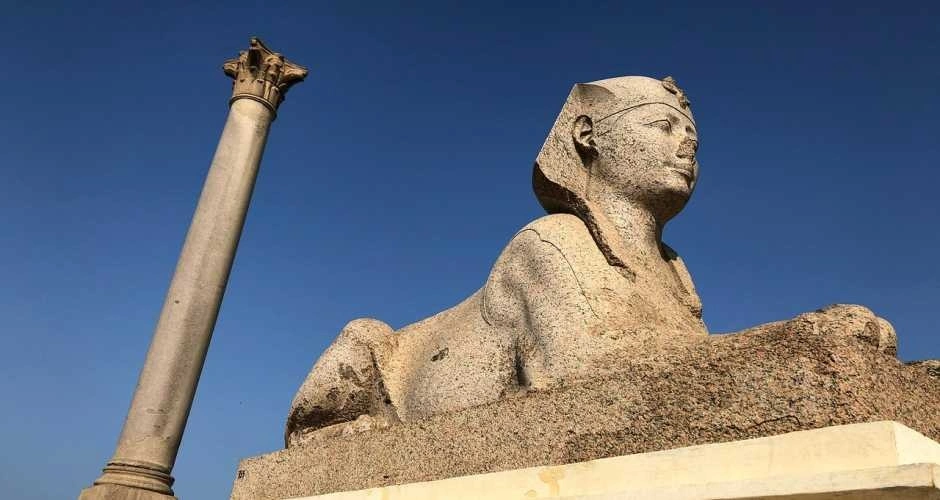
The Pompey's Pillar is a masterpiece of Roman engineering. The column shaft is carved from a single piece of red Aswan granite, transported over 900 kilometres from the quarries of Aswan in Upper Egypt.
The shaft stands 20.75 metres (68 feet) tall with a diameter of approximately 2.70 metres (8.9 feet) at its base, tapering to 2.30 metres at the crown. The total height of the column, including the base and capital, is approximately 26.85 metres (88 feet). Originally, the column also supported a colossal porphyry statue of the emperor in armour, which would have brought the total height to nearly 34 metres.
The column is distinguished by the precision of its carving — whether the cylindrical body of a single piece, the ornate Corinthian capital, or the massive base bearing the Greek inscription.
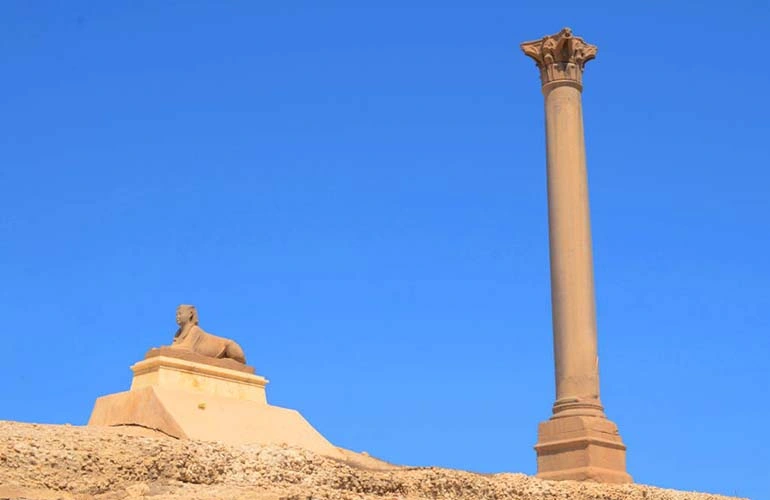
The column is topped by a magnificent Corinthian-style capital, decorated with acanthus leaves and scrollwork. This capital originally supported a colossal statue of the Emperor Diocletian in armour, carved from purple porphyry.
The statue is now lost, but the capital remains in place, offering visitors a glimpse of the column's original grandeur. The total height of the column, including the missing statue, would have been approximately 33.85 metres.
At the base of the Pompey's Pillar, visitors can still read the Greek dedicatory inscription that identifies the column's true purpose. The inscription reads: "Postumas, a governor of Alexandria, erected this pillar in honour of a just emperor Diocletian".
This inscription is a crucial piece of evidence that confirms the column's dedication to Diocletian, not Pompey. It has survived the centuries in remarkably good condition, offering a direct connection to the Roman-era builders who erected this monument.
For more on Alexandria's ancient history, check out our guide to the Bibliotheca Alexandrina .
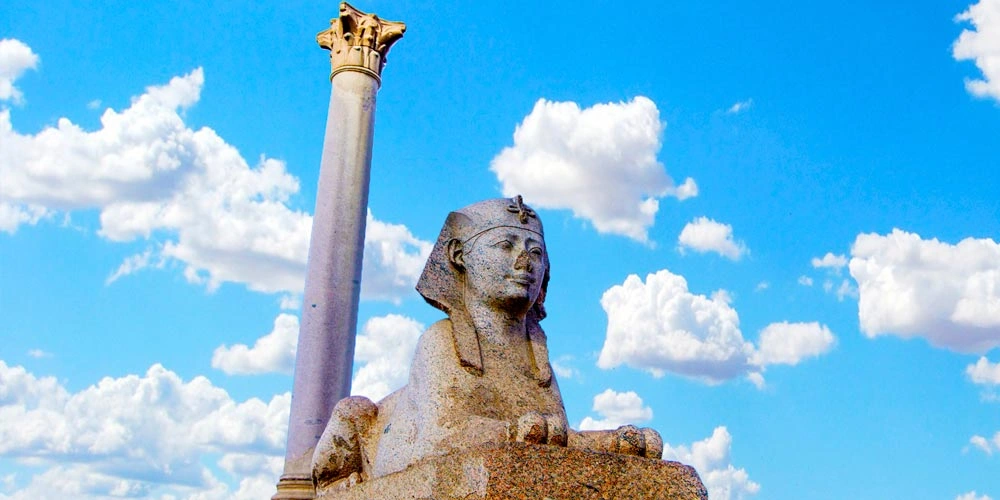
Pompey's Pillar is located in the Karmouz district of western Alexandria, on Abu Mandour Street. It sits on the elevated site of the ancient Serapeum, approximately 3 kilometres west of the city centre.
Getting there:
Pompey's Pillar is open daily:
Recommended visit duration: 30 minutes to 1 hour
Prices are estimates based on 2026 data and may change. Some sources report 80 EGP for foreigners, while others mention 150 EGP.
Note: The entrance fee is modest, making Pompey's Pillar one of the most affordable ancient sites in Egypt.
Pompey's Pillar itself is the highlight — but the surrounding site offers much more:
The best time to visit Pompey's Pillar is early morning (8:00–10:00 AM) or late afternoon (closer to sunset).
Why early morning:
Why late afternoon:
Best months: October to April offer the most comfortable temperatures for exploring Alexandria.
For more on timing your Egypt trip, check out our guide to the best time to visit Egypt .
Pompey's Pillar is ideally combined with other Alexandria highlights. Here's a suggested itinerary:
Alexandria Day Tour:
Alternative Half-Day Option:
Pompey's Pillar is conveniently located near the Catacombs of Kom El Shoqafa — approximately 1.5 kilometres away — making it easy to combine both sites in a single visit.
For more ideas, check out our guides to is Alexandria worth visiting and things to do and see in Cairo .
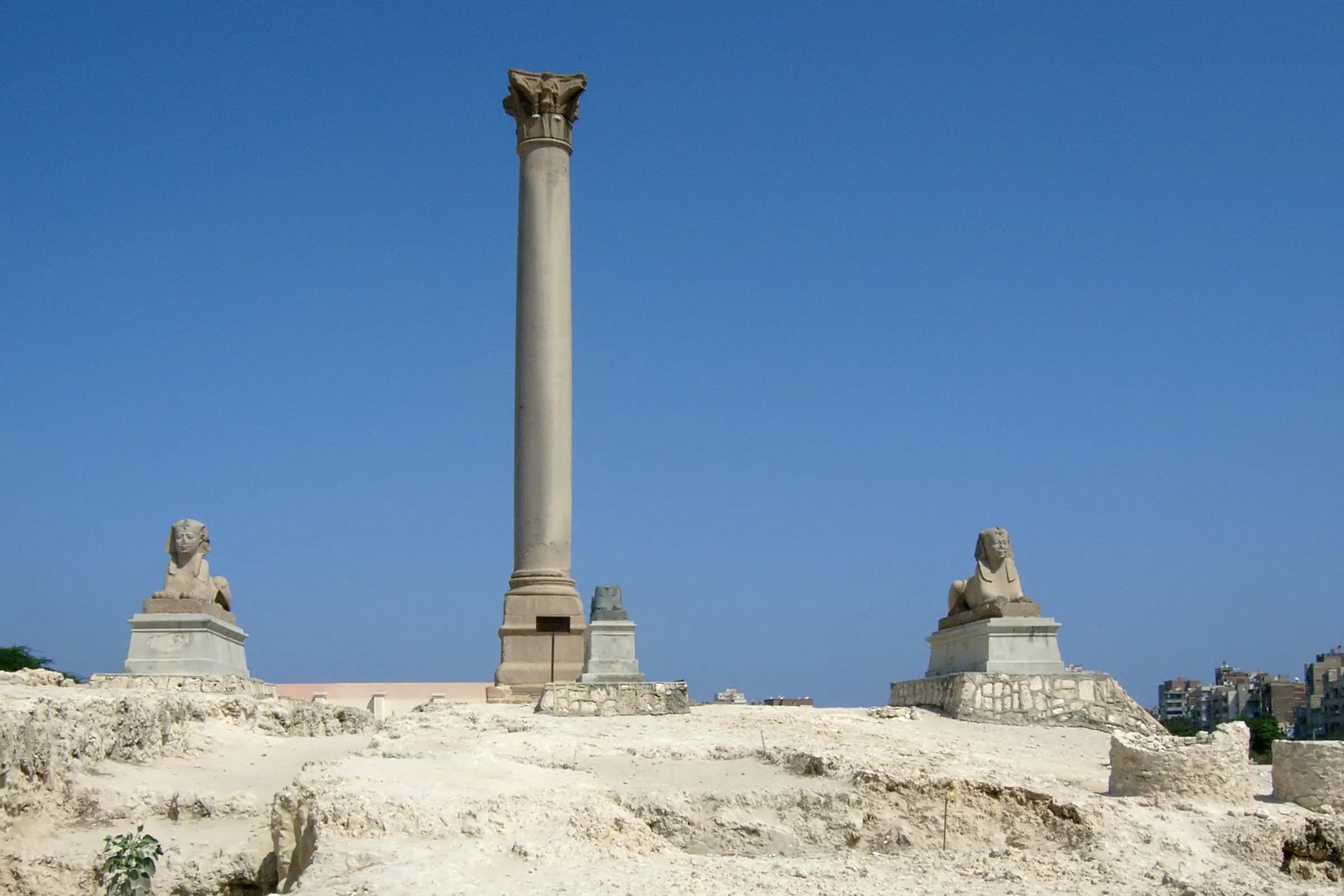
Pompey's Pillar is more than just an ancient column — it is the last surviving witness to Alexandria's Greco-Roman glory. Standing alone among the ruins of the Serapeum, this 27-metre red granite monument has outlasted earthquakes, invasions, and the rise and fall of empires. It is a reminder of the power of Rome, the ambition of the Ptolemies, and the dramatic transition from pagan to Christian Egypt. The Pompey's Pillar is not a ruin — it is a survivor.
But Pompey's Pillar is just one part of Alexandria's rich story. The city offers a wealth of experiences — from the historic Citadel of Qaitbay to the modern Bibliotheca Alexandrina , from the Catacombs of Kom El Shoqafa to the Mediterranean Corniche. For travelers wondering is Alexandria worth visiting , the answer is a resounding yes — and Pompey's Pillar is one of the crown jewels of any Alexandria itinerary.
That's where having the right local partner makes all the difference. Tour Guides Egypt connects you with trusted local professionals who know Alexandria inside out. Our Local Tour Guides are experts in the history of Pompey's Pillar — explaining the misnomer, decoding the Greek inscription, and sharing the stories of Diocletian, Serapis, and the destruction of the Serapeum that most visitors never hear. Our Tour Representatives handle logistics — transport, timing, and coordination — so you can focus on the experience. And when you need to move between the pillar and other Alexandria attractions, our Private Drivers provide comfortable, reliable transportation.
For travelers who want to combine a visit to Pompey's Pillar with other Egyptian highlights — the Pyramids of Giza , the Sphinx , and the things to do and see in Cairo — we can help you design a comprehensive itinerary. You can also plan a tailor-made Egypt trip that combines Alexandria with Cairo, Luxor, and the Nile.
Ready to stand before Pompey's Pillar? Reach out to us on [WhatsApp] for instant support — our team is ready to answer your questions about the Pompey's Pillar Alexandria, customize your itinerary, and turn your Egyptian journey into a discovery of Alexandria's ancient wonders. The last monument of Roman Alexandria is waiting — and we're here to help you uncover its secrets.
Q: What is Pompey's Pillar?
A: Pompey's Pillar is the largest ancient monolithic column outside Rome, standing approximately 27 metres tall in Alexandria, Egypt. Despite its name, it was erected in honour of the Roman Emperor Diocletian between 298–302 AD, not Pompey the Great.
Q: Where is Pompey's Pillar located?
A: Pompey's Pillar is located in the Karmouz district of western Alexandria, on the site of the ancient Serapeum.
Q: Why is it called Pompey's Pillar?
A: The name is a misnomer. Medieval Crusaders mistakenly believed that Pompey the Great was buried at the site and that his head was placed atop the column. The column was actually dedicated to Emperor Diocletian.
Q: How tall is Pompey's Pillar?
A: Pompey's Pillar stands approximately 26.85 metres (88 feet) tall, with the column shaft itself measuring 20.75 metres. Originally, with the statue of Diocletian on top, it would have been nearly 34 metres tall.
Q: What are the Pompey's Pillar opening hours?
A: Pompey's Pillar is open daily from 8:00 AM to 5:00 PM. Some sources report hours of 9:00 AM to 4:30 PM. Hours may vary during public holidays and Ramadan.
Q: How much is the Pompey's Pillar ticket price in 2026?
A: The Pompey's Pillar ticket price is approximately 80–150 EGP (~$3–4 USD) for foreign adults. Student discounts are available with valid ID.
Q: How long should I spend at Pompey's Pillar?
A: Most visitors spend 30 minutes to 1 hour at Pompey's Pillar — enough time to see the column, explore the ruins, and read the inscription.
Q: What is the Serapeum?
A: The Serapeum was the great temple of the Greco-Egyptian god Serapis, built by Ptolemy III in the 3rd century BCE. It was destroyed by a Christian mob in 391 AD. Pompey's Pillar is the last surviving monument from this once-magnificent complex.
Q: What can I see at Pompey's Pillar?
A: At Pompey's Pillar, you can see the massive red granite column, two pink granite sphinxes, the ruins of the Serapeum, subterranean galleries where sacred Apis bulls were buried, and the Greek dedicatory inscription.
Q: Is Pompey's Pillar wheelchair accessible?
A: The site has some accessibility challenges due to uneven ground and stairs. Check current accessibility before your visit.
Q: Can I climb Pompey's Pillar?
A: No. Pompey's Pillar is a protected archaeological site. Visitors are not permitted to climb the column.
Q: What is the best time to visit Pompey's Pillar?
A: The best time to visit Pompey's Pillar is early morning (8:00–10:00 AM) or late afternoon for cooler temperatures and the best light for photography.
Q: What is the best way to get to Pompey's Pillar?
A: The best way to get to Pompey's Pillar is by taxi (ask for "Amoud El-Sawari"), by private driver, or as part of an Alexandria day tour. For a hassle-free experience, Tour Guides Egypt can arrange Private Drivers .
Q: What should I wear to visit Pompey's Pillar?
A: Wear comfortable, breathable clothing suitable for warm weather. Sun protection — a hat, sunglasses, and sunscreen — is essential as the site has limited shade. Comfortable walking shoes are recommended.
Q: What else can I see near Pompey's Pillar?
A: Nearby attractions include the Citadel of Qaitbay , the Bibliotheca Alexandrina , and the Catacombs of Kom El Shoqafa. The Catacombs are approximately 1.5 kilometres away.
Q: Do I need a guide for Pompey's Pillar?
A: While you can visit independently, a licensed guide can explain the history, the misnomer, and the significance of the Serapeum. For more on guide costs, check out our guide to Egypt tour guide price .
Q: What is the best currency to take to Egypt?
A: The best currency to take to Egypt is US dollars or euros, which are widely accepted. The Egyptian pound (EGP) is used for daily expenses.
Q: Is it safe to visit Pompey's Pillar?
A: Yes. Egypt is safe for tourists who follow standard precautions. Pompey's Pillar is a well‑established tourist destination with a strong security presence.
Q: Do I need a visa to visit Egypt?
A: Most nationalities require a visa. Check the Egypt visa on arrival countries list to see if you qualify. US citizens can obtain an Egypt visa on arrival or apply for an e-Visa.

Learn how to hire the right Aswan Tour Guide. Compare prices, verify licenses, and book a private guide A ...

Luxor Egypt tour guides 2026 — English guides from $70/day, other languages from $100/day. How to choose ...

Edfu Temple Egypt 2026 — history, tickets, and visitor tips for the Temple of Horus at Edfu. Complete gui ...
Get Updates & More
@ Copy 2026 Tour Guides Egypt , All rights reserved